> ## Documentation Index
> Fetch the complete documentation index at: https://documentation.onesignal.com/llms.txt
> Use this file to discover all available pages before exploring further.
# Mobile SDK setup
> Set up the OneSignal SDK for Android, iOS, Huawei, Amazon, and cross-platform frameworks like React Native, Expo, Flutter, Unity, Cordova, and Capacitor.
export const SdkReleasesIframe = ({sdkFilter = undefined, viewMode = undefined, height, ...frameProps}) => {
const baseUrl = 'https://onesignal.github.io/sdk-releases';
const buildUrl = (theme, sdkFilter, viewMode) => {
const url = new URL(baseUrl);
const params = new URLSearchParams();
if (theme) {
params.set('theme', theme);
}
if (sdkFilter) {
params.set('sdk', sdkFilter);
}
if (viewMode) {
params.set('viewMode', viewMode);
}
if (params.toString()) {
url.search = params.toString();
}
return url.toString();
};
const detectTheme = () => {
if (document.documentElement.classList.contains('dark')) {
return 'dark';
}
return 'light';
};
const [theme, setTheme] = useState('light');
const [iframeSrc, setIframeSrc] = useState(() => {
const initialTheme = detectTheme();
return buildUrl(initialTheme, sdkFilter, viewMode);
});
useEffect(() => {
const currentTheme = detectTheme();
setTheme(currentTheme);
setIframeSrc(buildUrl(currentTheme, sdkFilter, viewMode));
const mediaQuery = window.matchMedia('(prefers-color-scheme: dark)');
const handleThemeChange = () => {
const newTheme = detectTheme();
setTheme(newTheme);
setIframeSrc(buildUrl(newTheme, sdkFilter, viewMode));
};
if (mediaQuery.addEventListener) {
mediaQuery.addEventListener('change', handleThemeChange);
} else {
mediaQuery.addListener(handleThemeChange);
}
window.addEventListener('storage', handleThemeChange);
const observer = new MutationObserver(handleThemeChange);
observer.observe(document.documentElement, {
attributes: true,
attributeFilter: ['class', 'data-theme']
});
return () => {
if (mediaQuery.removeEventListener) {
mediaQuery.removeEventListener('change', handleThemeChange);
} else {
mediaQuery.removeListener(handleThemeChange);
}
window.removeEventListener('storage', handleThemeChange);
observer.disconnect();
};
}, [sdkFilter, viewMode]);
const getIframeHeight = () => {
if (viewMode === 'table') {
return '450';
}
if (viewMode === 'mini') {
return '170';
}
return '800';
};
const iframeHeight = height || getIframeHeight();
return
;
};
The OneSignal mobile SDK enables [push notifications](./push), [in-app messages](./in-app-messages-setup), and [Live Activities](./live-activities) in your iOS, Android, Huawei, and Amazon apps. Setup has two steps:
1. **Configure platform credentials**: connect your FCM, APNs, HMS, or ADM credentials to OneSignal
2. **Integrate the SDK**: install the OneSignal SDK for your platform and initialize it in your app
For websites, see [Web SDK setup](./web-sdk-setup).
***
## Configure your OneSignal app and platform
Configure your OneSignal app with the platforms you support — Apple (APNs), Google (FCM), Huawei (HMS), and/or Amazon (ADM).
If your organization already has a OneSignal account, [ask to be invited](/docs/en/manage-team-members) to the Organization. Otherwise, [sign up for a free account](https://onesignal.com) to get started.
Create a new app by clicking **New App/Website**, or add a platform to an existing app in **Settings > Push & In-App**. Select the platform(s) you want to configure and click **Next: Configure Your Platform**.
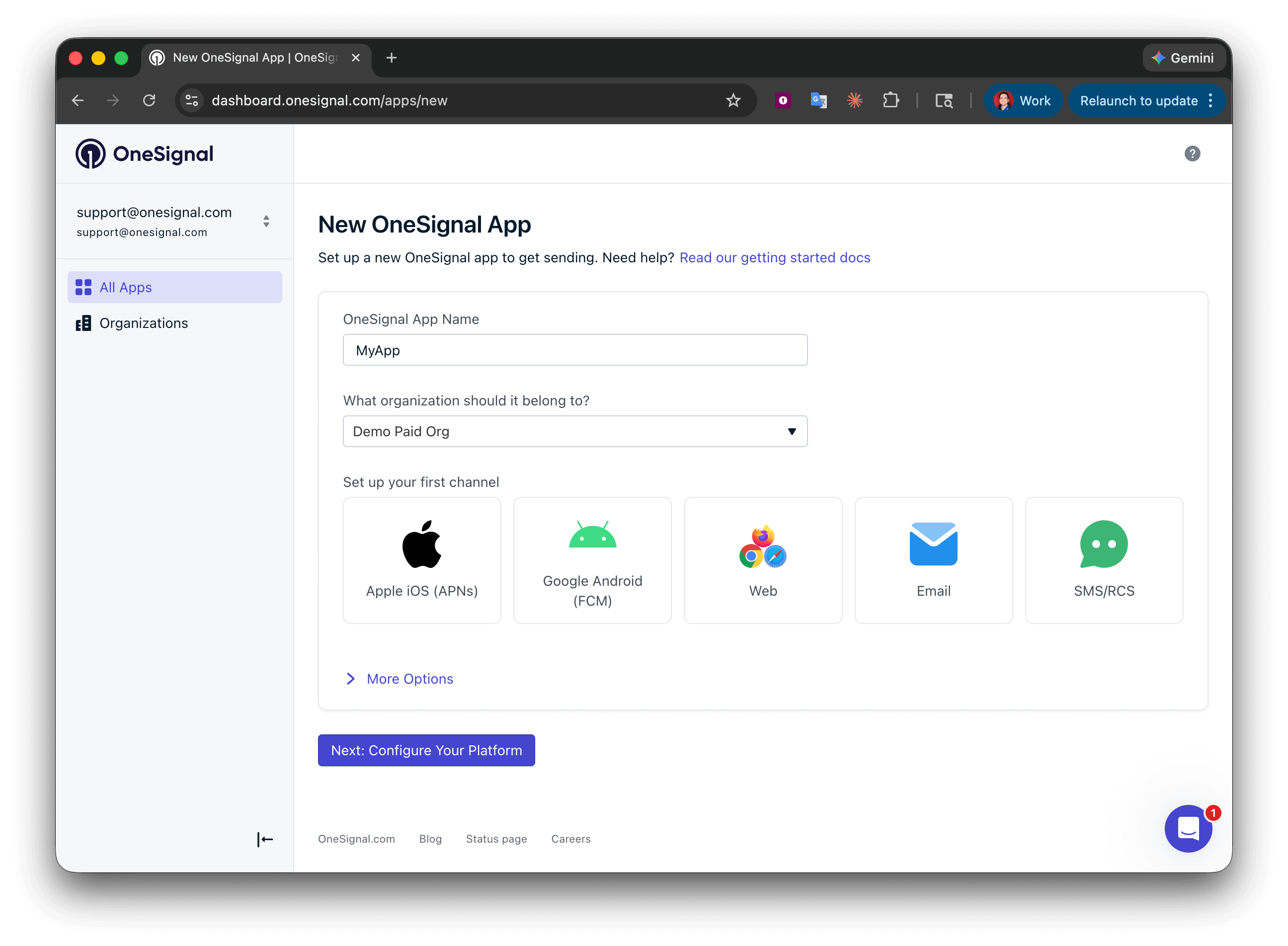 Enter the credentials for your platform:
* **Android**: [Set up Firebase credentials](/docs/en/android-firebase-credentials)
* **iOS**: [p8 token (recommended)](/docs/en/ios-p8-token-based-connection-to-apns) or [p12 certificate](/docs/en/ios-p12-generate-certificates)
* **Amazon**: [Generate API key](/docs/en/generate-an-amazon-api-key)
* **Huawei**: [Authorize OneSignal](/docs/en/authorize-onesignal-to-send-huawei-push)
Click **Save & Continue** after entering your credentials.
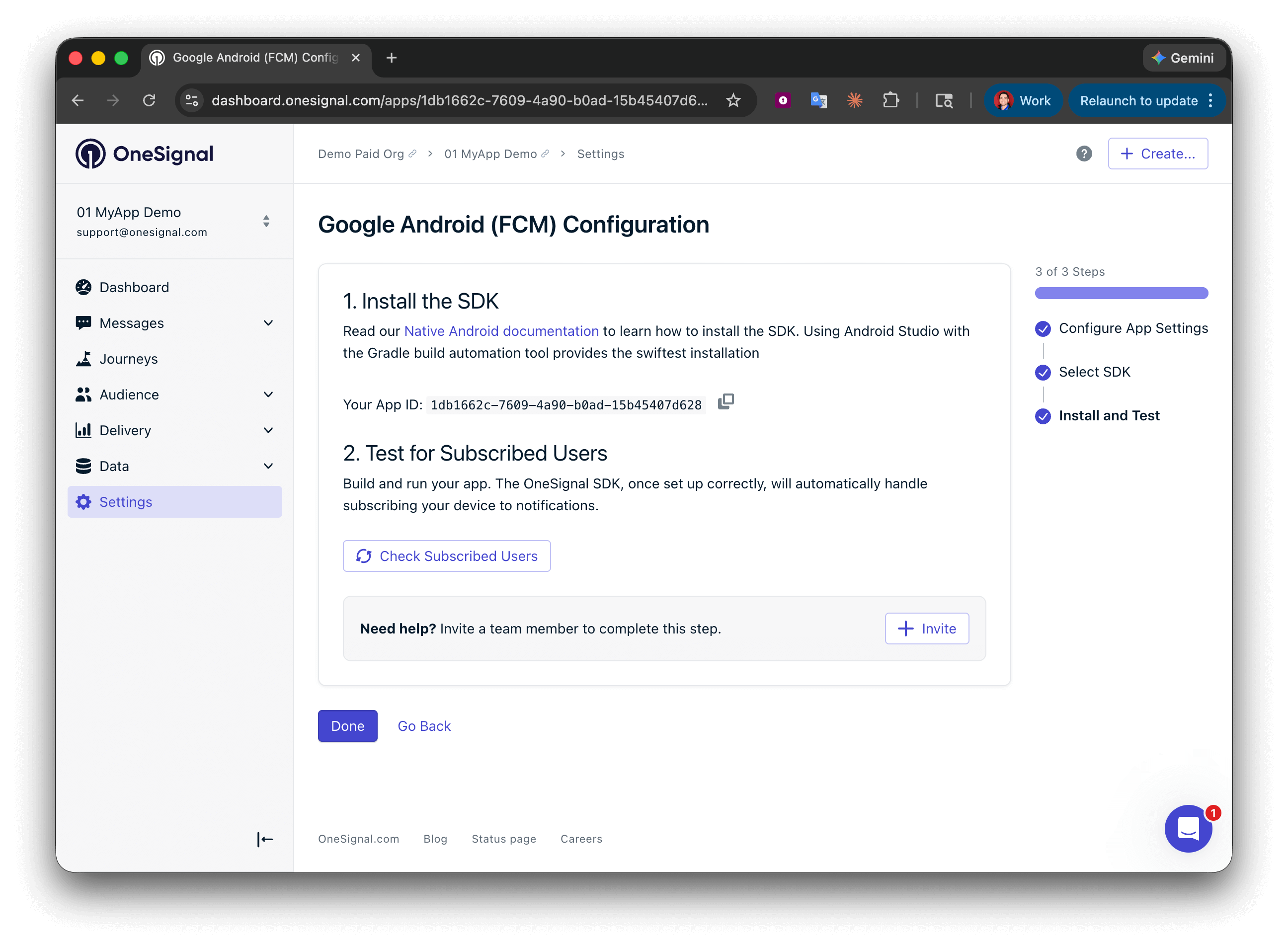
Your **App ID** is displayed on the final screen. Copy and save it — you need it when initializing the SDK. Select your SDK platform, then follow the setup guide.
Enter the credentials for your platform:
* **Android**: [Set up Firebase credentials](/docs/en/android-firebase-credentials)
* **iOS**: [p8 token (recommended)](/docs/en/ios-p8-token-based-connection-to-apns) or [p12 certificate](/docs/en/ios-p12-generate-certificates)
* **Amazon**: [Generate API key](/docs/en/generate-an-amazon-api-key)
* **Huawei**: [Authorize OneSignal](/docs/en/authorize-onesignal-to-send-huawei-push)
Click **Save & Continue** after entering your credentials.
Your **App ID** is displayed on the final screen. Copy and save it — you need it when initializing the SDK. Select your SDK platform, then follow the setup guide.
 ***
## Integrate the SDK
Native Android apps using FCM.
Native iOS apps using APNs.
Amazon Fire OS apps using ADM.
Huawei devices using HMS.
Bare React Native apps.
Managed Expo apps with EAS Build.
Flutter apps using Dart.
Unity apps for iOS, Android, Amazon, and Huawei.
.NET MAUI apps for iOS and Android.
Cordova and Ionic Cordova hybrid apps.
Capacitor and Ionic Capacitor hybrid apps.
### Other integrations
Low-code FlutterFlow apps.
Median.co (formerly GoNative.io) web-to-app apps.
***
## After setup
Identify Users, test delivery, and look up SDK methods as you build.
Call `login` with an External ID to identify Users across devices and channels.
Verify delivery, rendering, and deep links before sending to your full audience.
Methods, classes, and event hooks for iOS, Android, and cross-platform SDKs.
Resolve common push delivery, APNs, and in-app messaging issues.
### SDK versions
***
## FAQ
### Do I need separate OneSignal apps for iOS and Android?
No. A single OneSignal App supports multiple platforms: iOS, Android, Huawei, Amazon, and web. Configure each platform's credentials in **Settings > Push & In-App** and they all share the same app, users, and segments.
### Can devices in China or on Huawei receive push notifications?
If the device has Google Play Services, it receives push through FCM. If the app was downloaded from the Huawei AppGallery (including non-HarmonyOS Huawei devices running Android), it receives push through HMS. Set up the [Huawei SDK](./huawei-sdk-setup) to enable this. OneSignal defaults to FCM for devices that support both HMS and FCM. You can [prefer HMS over FCM](./huawei-sdk-setup#prefer-hms-over-fcm-optional) if needed.
This documentation is built and hosted on [Mintlify](https://mintlify.com), a developer documentation platform.
***
## Integrate the SDK
Native Android apps using FCM.
Native iOS apps using APNs.
Amazon Fire OS apps using ADM.
Huawei devices using HMS.
Bare React Native apps.
Managed Expo apps with EAS Build.
Flutter apps using Dart.
Unity apps for iOS, Android, Amazon, and Huawei.
.NET MAUI apps for iOS and Android.
Cordova and Ionic Cordova hybrid apps.
Capacitor and Ionic Capacitor hybrid apps.
### Other integrations
Low-code FlutterFlow apps.
Median.co (formerly GoNative.io) web-to-app apps.
***
## After setup
Identify Users, test delivery, and look up SDK methods as you build.
Call `login` with an External ID to identify Users across devices and channels.
Verify delivery, rendering, and deep links before sending to your full audience.
Methods, classes, and event hooks for iOS, Android, and cross-platform SDKs.
Resolve common push delivery, APNs, and in-app messaging issues.
### SDK versions
***
## FAQ
### Do I need separate OneSignal apps for iOS and Android?
No. A single OneSignal App supports multiple platforms: iOS, Android, Huawei, Amazon, and web. Configure each platform's credentials in **Settings > Push & In-App** and they all share the same app, users, and segments.
### Can devices in China or on Huawei receive push notifications?
If the device has Google Play Services, it receives push through FCM. If the app was downloaded from the Huawei AppGallery (including non-HarmonyOS Huawei devices running Android), it receives push through HMS. Set up the [Huawei SDK](./huawei-sdk-setup) to enable this. OneSignal defaults to FCM for devices that support both HMS and FCM. You can [prefer HMS over FCM](./huawei-sdk-setup#prefer-hms-over-fcm-optional) if needed.
This documentation is built and hosted on [Mintlify](https://mintlify.com), a developer documentation platform.